Friday, January 3, 2014

Malcolm X killer freed after 44 years

   Thomas Hagan was captured shortly after the assassination of Malcolm X on Feburary 21, 1965.
    Thomas Hagan was captured shortly after the assassination of Malcolm X on Feburary 21, 1965

(CNN) -- Thomas Hagan, the only man who admitted his role in the 1965 assassination of iconic black leader Malcolm X, was paroled Tuesday.
Hagan was freed a day earlier than planned because his paperwork was processed more quickly than anticipated, according to the New York State Department of Correctional Services.
Hagan, 69, walked out of the minimum-security Lincoln Correctional Facility at 11 a.m. The facility is located at the intersection of West 110th Street and Malcolm X Boulevard.
Hagan had been in a full-time work-release program since March 1992 that allowed him to live at home with his family in Brooklyn five days a week while reporting to the prison just two days.
Last month, Hagan pleaded his case for freedom: To return to his family, to become a substance abuse counselor and to make his mark on what time he has left in this world.
He was dressed in prison greens as he addressed the parole board. He had been before that body 14 other times since 1984. Each time, he was rejected.
Hagan was no ordinary prisoner. He is the only man to have confessed in the killing of Malcolm X, who was gunned down while giving a speech in New York's Audubon Ballroom in 1965.
"I have deep regrets about my participation in that," he told the parole board on March 3, according to a transcript. "I don't think it should ever have happened."
Hagan had been sentenced to 20 years to life imprisonment after being found guilty at trial with two others in 1966. The other two men were released in the 1980s and have long denied involvement in the killing.
To win his release, Hagan was required to seek, obtain and maintain a job, support his children and abide by a curfew. He must continue to meet those conditions while free. He told the parole board he's worked the same job for the past seven years. He told the New York Post in 2008 he was working at a fast-food restaurant.
A parole officer checked on him while outside prison, and he had to undergo random drug tests.
CNN was unable to reach Hagan for a comment about his release. The Nation of Islam declined comment for this story.
Malcolm X is best known as the fiery leader of the Nation of Islam who denounced whites as "blue-eyed devils." But at the end of his life, Malcolm X changed his views toward whites and discarded the Nation of Islam's ideology in favor of orthodox Islam. In doing so, he feared for his own life from within the Nation.
Malcolm X remains a symbol of inspiration for black men, in particular, who are moved by his transformation from a street hustler to a man the late African-American actor Ossie Davis eulogized as "our own black shining prince."
The ballroom where he was killed has now been converted into The Malcolm X & Dr. Betty Shabazz Memorial and Educational Center. Board Chairman Zead Ramadan said the center doesn't have a position on Hagan's release.
"I personally find it strange that for a couple decades any person convicted in the assassination of such an iconic figure would be allowed such leniency," Ramadan said.
There's outrage among some African-Americans, he said, that he's being released. Would he be set free if he had killed an iconic white leader?
"It's really a struggle for Muslims to contemplate this issue, because our faith and our religion is full of examples where we have to exert mercy," he added. "The Malcolm X story has not ended. His populuarity has grown in death. ... Only God knows why this was allowed to happen."
The center is preparing for a special service next month to celebrate what would have been Malcolm X's 85th birthday. Would the center welcome Hagan if he asked to attend?
"We'd cross that bridge if he called us," Ramadan said, "Think about that: How far-fetched is it that he could meet one of the daughters of Malcolm X? And what's going to happen then? Mercy, fury, anger, emotions -- who knows?"
Killed in front of his family
On February 21, 1965, Malcolm X took to the stage of the Audubon Ballroom, a site often used for civic meetings. His wife, Betty Shabazz, and four children were in the crowd.
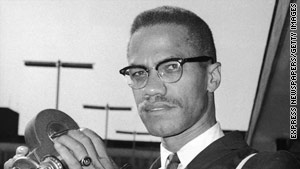
Malcolm X was 39 when he was gunned down in 1965.
Malcolm X was 39 when he was gunned down in 1965
"I heard several shots in succession," his wife later told a Manhattan grand jury. "I got on the floor, and I pushed my children under the seat and protected them with my body."
Gunshots continued to ring out, she said. Her husband's body was riddled with bullets. The native of Omaha, Nebraska, was 39.
"Minister Malcolm was slaughtered like a dog in front of his family," A. Peter Bailey, one of Malcolm X's closest aides, told The New York Times on the 40th anniversary of the killing.
The assassination came after a public feud between Malcolm X and the Nation of Islam's founder, Elijah Muhammad. Malcolm X had accused Muhammad of infidelity and left the Nation in March 1964.
"For the next 11 months, there was a pattern of harassment, vilification and even on occasion literally pursuit in the streets of Malcolm by people associated with the Nation," said Claude Andrew Clegg III, author of a biography on Elijah Muhammad called An Original Man.
"Malcolm felt that if Elijah Muhammad snapped his fingers, then he could stop the escalation of the violent tone around the split of the two men. And I think there's some truth to that."
Over the years, the killing of Malcolm X has been the subject of much debate, with conspiracy theories involving the Nation of Islam and others. The Nation of Islam has repeatedly denied any involvement in Malcolm X's assassination.
On a deadly mission
Thomas Hagan is pictured here in a mugshot from 2008.Thomas Hagan is pictured here in a mugshot from 2008.


Hagan, then known by the name Talmadge X Hayer, was in his early 20s and a radical member of the Nation of Islam the day he entered the ballroom armed and ready to kill. His allegiance was to the Nation's founder, and he was outraged Malcolm X had broken from its ranks.
After the shooting, Hagan tried to flee the scene but he was shot in the leg. He was beaten by the crowd before being arrested outside.
Last month, he told the parole board he felt the urge to kill Malcolm X because of his inflammatory comments about the Nation's founder.
"It stemmed from a break off and confusion in the leadership," Hagan said. "Malcolm X broke with the Nation of Islam, separated from the Nation of Islam, and in doing so there was controversy as to some of the statements he was making about the leader."
He added, "History has revealed a lot of what Malcolm X was saying was true."
Two other men, Muhammad Abdul Aziz and Kahlil Islam, were also found guilty of murder in 1966 and received 20 years to life. Both proclaimed their innocence. Hagan, who eventually admitted his part in the murder, testified at trial and subsequent parole hearings that both men were innocent. Aziz was paroled in 1985; Islam was freed in 1987.
At last month's parole hearing, Hagan again maintained that Aziz and Islam were not the other assassins. He said it was two other men who helped plot, plan and participate in the killing.
Did they receive orders from the Nation to carry out the killing?
"I can't say that anyone in the Nation of Islam gave us the idea or instructed us to do it. We did this ourselves for the most part, yes," Hagan told the parole board.
Hagan said he received a master's degree in sociology while incarcerated and that helped him deal with his actions from 45 years ago.
"I understand a lot better the dynamics of movements and what can happen inside movements and conflicts that can come up, but I have deep regrets about my participation in that."
He added, "Unfortunately, I didn't have an in-depth understanding of what was really going on myself to let myself be involved in anything like that. ... I can't really describe my remiss and my remorse for my actions -- basically a very young man, a very uneducated man. "
He is still a Muslim but no longer a member of the Nation of Islam. He volunteers at a mosque to help young men. He told the parole board he hopes to become a qualified substance abuse counselor.
His primary mission is to help his four children, ages 21, 17, 14 and 10. He has two other grown children.
"My focus is to maintain my family and to try to make things a little better for them. It's upward mobility, and to encourage my children to complete their education because it's a must."


Thursday, January 2, 2014

Over 10,000 Killed in Iraq in 2013, Worst Since 2007

1,180 Killed in December, Capping a Grim Year

2013 in Iraq began much the way 2012 did, with violence well down from the levels of the US occupation era. Then the Maliki government attacked a peaceful protest in Hawija in mid-April, and a sectarian powderkeg just exploded.
IraqBy summer the death tolls were again rivaling the worst of the US surge-era, and 2013 ended with well over 10,000 dead, and 1,180 killed in the month of December alone. The toll is the worst since 2007.
2013 in Iraq included a 3 and a half month span of relative calm too, before the Hawija killings and this week’s Ramadi killings bookmarked the remainder of the year, killing protesters and sparking ever-worsening tensions.
If something isn’t done to calm those tensions, 2014 is going to be the same, only moreso. Anbar Province is on the brink of full-scale revolt at this point, and the Maliki government’s answer so far is to keep sending the same troops in for heavy-handed crackdowns that only make matters worse. How much worse can Iraq possibly get? Sadly, we may be about to find out.

Monday, December 30, 2013

Super Market Selling Food From It's Huge Organic Rooftop Garden Opening This Month


Whole Foods has announced that it will be opening its long-awaited Gowanus store on December 17th this year. In addition to putting the usual organic and artisan products on it shelves, the new location at 214 3rd Street will bring the local food trend to new heights with a 20,000 square foot rooftop farm right on top of the building. It doesn’t get more local than that!


The rooftop farm was made possible thanks to a partnership with Gotham Greens, a Greenpoint-based rooftop farm. The two organizations are calling the endeavor the first commercial-scale greenhouse farm and say that it will help reduce the carbon emissions spent on transporting food from far away sources. The elevated greenhouse will grow high-quality, pesticide-free produce all year round to be sold at the bustling supermarket below.

Other attractions at the grocery store will include a bar with 16 different types of beer on tap. The store will also have its own ramen shop headed up by ramen master Yuji Hariguchi for eat-in and take-out options. It opens a little too late for Thanksgiving, but people in the Gowanus area will have a tasty and green treat to look forward to just a month later.


Read more at http://isupportorganic.blogspot.com/2013/12/super-market-selling-food-from-its-huge.html#WuYQHBzKwRBgFf1V.99

Thursday, December 26, 2013

White Teacher to Black Student: We Don’t Need Another Black President


Teacher suspended for alleged comment

Several students report racial remark to an African-American

                              1388087558

Gil Voigt, a science teacher in Ohio, has been suspended for allegedly making the comment to an African-American teen boy with presidential aspirations.


School teacher has been suspended without pay and faces the prospect of dismissal after allegedly making racially insensitive statements to a student earlier this month.
Monday, the Fairfield Board of Education suspended science teacher Gil Voigt. He has 10 days to request a hearing before the school board or a referee.
Voigt, who is white, is accused of telling an African-American male student, We do not need another black president after the student said he would like to become president.
The incident occurred on Dec. 3, with several other students present, according to a report from Assistant Superintendent Roger Martin, who conducted a disciplinary hearing on the matter.
It isn't the first time the 14-year Fairfield teacher has been disciplined. He received a verbal warning for making an inappropriate racial comment in 2008. That year he also received a verbal warning for improper use of school technology.
Last year he received a verbal warning after allegedly calling a student stupid and belittling him. He received a written warning last month for failure to use the adopted curriculum.
This is a rare occurrence. This is the first time I've faced it since being named assistant superintendent (in 2011) Martin said.
In his report, Martin said he believed four students were interviewed who corroborated the student Voigt was speaking to.
Following a complaint by the students parents, the teen was removed from Voigts class, Martin said.
We intend to uphold board policies and to hold teachers accountable for the essential functions of the teacher job description, Martin said.
Voigt is accused of violating board policies related to staff ethics, staff-student relations and harassment.
Voigt was not present at the meeting and could not be reached on Monday for comment.
According to the report, Voigt said his statement was misquoted by the student, who he said was not a very good student and was troublesome in class.
Voigt has been a Fairfield teacher since 2000. Before that he taught seven years in North Carolina, two years in Florida and six years in the Cincinnati Public Schools. ■

Link: No More Black Presidents

Wednesday, December 25, 2013

Jewish businessman calls black people ”liquid money”: Because we give it all away


Someone I know works closely with a Jewish businessman. *One day, the two had an honest conversation, in which the Jewish man asked, “Do you know what my Jewish friends call the black community?”
120516125955_Cash Money
 My friend said, “No, what do they call us?” 

He replied, “We call you liquid money. The same way that water falls out of a man’s hands, money typically seeps out of a black person’s hands the same way. Your community gets money and immediately gives it all away to people who aren’t black. *We see that as a huge business opportunity.”

 He then used the example of many black people on payday or when we get our tax refunds. *He noted how we’ll go to an Indian business to cash the check, an Asian hair salon, a corner store owned by Arabs and a department store owned by whites. *He explained how, when it’s all said and done, these other business people are waiting like hungry animals to eat our bank accounts as if we are the prey.

 This is not an attack on Jewish people, but a lesson on how ignorant we look when we keep giving all of our money away. *Part of the New Paradigm Construct is to help all of us understand the importance of finding ways to keep money in our own communities, the same way you plant a seed from a piece of fruit in order to grow more fruit in your garden. If you’re always waiting for someone else to feed you, you are typically an inch or two away from starvation.

 It’s something to think about. Here’s the lesson: 
1) In America, you have no almost no power if you don’t own something. *There is no pride in a platform on which you sit if it can be taken away from you on a second’s notice. *You have been seduced into believing that you have real power, when the truth is that you do not.

 2) If we never learn the value of supporting of black-owned businesses, we are always going to be disappointed. *We are going to have the highest unemployment rates, the lowest wealth levels and the greatest degrees of frustration. *When I had a three hour personal conversation with Min. Louis Farrakhan (followed by a nine-hour closed economic summit a month later), one point that he made (which I agree with entirely) is that black people can learn a great deal from watching how the Jewish community handles it’s wealth. *In order for us to grow as a people, we must realize this important fact: *Our money is our power and we cannot give it all away.


Chinese Scientist Proves The First Inhabitants Of China Were Black!


Black Chinese Out Of Africa


For many years Black historians and Afrocentrists have said that the first inhabitants of China were black Africans.
"The Negroid races peopled at some time all the South of India, Indo-China and China. The South of Indo-China actually has now pure Negritos as the Semangs and mixed as the Malays and the Sakais."( H. Imbert, "Les Negritos de la Chine").
“Even the sacred Manchu dynasty shows this Negro strain. The lower part of the face of the Emperor Pu-yi of Manchukuo, direct descendant of the Manchu rulers of China, is most distinctly Negroid. Chinese chroniclers report that a Negro Empire existed in the South of China at the dawn of that country's history".( Professor Chang Hsing-Lang , "The importation of Negro Slaves to China under the Tang Dynasty A.D. 618-907)
“There is evidence of substantial populations of Blacks in early China. Archaeological studies have located a black substratum in the earliest periods of Chinese history, and reports of major kingdom ruled by Blacks are frequently in Chinese documents." (Kwang-Chih Chang, The Archaeology of Ancient China, (Yale University Press) and Irwin Graham, Africans Abroad (Columbia University Press).
But after hundreds of years of the worldwide spread of the doctrine of white superiority and the inferiority of black Africans and their descendants. This notion that blacks were the original inhabitants of China was poo, pooed by white scientists and others and even by some blacks.
But in 2005, a Chinese DNA specialist, Jin Li, leading a team of Chinese and other scientists, proved through DNA tests that indeed the first inhabitants of China were black Africans.

The DNA Evidence

Li said he was trying to prove that the Chinese evolved from homo erectus independently of all other humans. He collected DNA samples from 165 different ethnic groups and over 12000 samples in China and Asia to test his theory. Li said he was taught through China’s education system that there was something special about Chinese, and because he was Chinese, he was hoping to prove that the Chinese developed independently of all other humans.
But surprise, surprise, surprise, surprise that proved not to be true!
Li’s team focused on a single genetic marker that appeared about 80,000 years ago in Africa. Anyone carrying that marker would have recent African ancestors and could not be descended from the more ancient Homo Erectus. Li and his team found that early humans belonged to different species but modern humans descended from the East Africans species.
Li Hui, a scientist on Li’s team, said, that 100,000 years ago groups of humans started leaving Africa moving through South and Southeast Asia into China, and that 65 branches of the Chinese groups studied carry similar DNA mutations as the people of Southeast Asia.
Jin Li, another scientist on Li's team, said “we did not see even one single individual that could be considered as a descendant of the homo erectus in China, rather, everybody was a descendant of our ancestors from Africa."
Li was asked how he as a Chinese felt about what he found. He said “after I saw the evidence generated in my laboratory. I think we should all be happy with that. Because after all, modern humans from different parts of the world are not so different from each other and we are very close relatives.” (Amen Brother!) Li’s team was composed of an international group of scientist from China, Russia, India, Brazil and other nations. This was a 5 year project to study the geographic and genealogical routes tracing the spread and settlements of ancient and modern humans.
Now DNA tests prove, what the Afrocentric historians have been asserting for years is true, that all modern human originated on some part of the African continent. Believe It Or Not, (or for some of you, read em and weep)
I'll leave you with the wise words of Richard Leaky,

Richard Leaky

"If you get to the stage where you can persuade people on the evidence, that it's solid, that we are all African, that color is superficial, that stages of development of culture are all interactive, then I think we have a chance of a world that will respond better to global challenges." Richard Leaky, Paleoanthropologist


Saturday, December 21, 2013

Yemen Wedding Deaths Test Claims of New Drone Policy

   
A mural depicting an American drone in Sana, Yemen’s capital. A strike last week on a wedding convoy killed at least 12 people.


WASHINGTON — In some respects, the drone strike in Yemen last week resembled so many others from recent years: A hail of missiles slammed into a convoy of trucks on a remote desert road, killing at least 12 people.

But this time the trucks were part of a wedding procession, making the customary journey from the groom’s house to the house of the bride.
The Dec. 12 strike by the Pentagon, launched from an American base in Djibouti, killed at least a half-dozen innocent people, according to a number of tribal leaders and witnesses, and provoked a storm of outrage in the country. It also illuminated the reality behind the talk surrounding the Obama administration’s new drone policy, which was announced with fanfare seven months ago.
President Obama on Drones
Although American officials say they are being more careful before launching drone strikes in Yemen, Pakistan and elsewhere — and more transparent about the clandestine wars that President Obama has embraced — the strike last week offers a window on the intelligence breakdowns and continuing liability of a targeted killing program that remains almost entirely secret.
Both the Pentagon and the C.I.A. continue to wage parallel drone wars in Yemen, but neither is discussed publicly. A Pentagon spokeswoman declined to comment about the Dec. 12 strike, referring a reporter to a vague news release issued last week by the government of Yemen, written in Arabic.
It remains unclear whom the Americans were trying to kill in the strike, which was carried out in a desolate area southeast of Yemen’s capital, Sana. Witnesses to the strike’s aftermath said that one white pickup truck was destroyed and that two or three other vehicles were seriously damaged. The Associated Press reported Friday that the target of the strike was Shawqi Ali Ahmad al-Badani, a militant who is accused of planning a terrorist plot in August that led to the closing of more than a dozen United States Embassies. American officials declined to comment about that report.
At first, the Yemeni government, a close partner with the Obama administration on counterterrorism matters, said that all the dead were militants. But Yemeni officials conceded soon afterward that some civilians had been killed, and they gave 101 Kalashnikov rifles and about 24 million Yemeni riyals (about $110,000) to relatives of the victims as part of a traditional compensation process, a local tribal leader said.
Yemeni government officials and several local tribal leaders said that the dead included several militants with ties to Al Qaeda’s branch in Yemen, but no one has been able to identify them. Some witnesses who have interviewed victims’ families say they believe no militants were killed at all.
The murky details surrounding the strike raise questions about how rigorously American officials are applying the standards for lethal strikes that Mr. Obama laid out in a speech on May 23 at the National Defense University — and whether such standards are even possible in such a remote and opaque environment.
In the speech, the president said that targeted killing operations were carried out only against militants who posed a “continuing and imminent threat to the American people.” Over the past week, no government official has made a case in public that the people targeted in the strike posed a threat to Americans.
Moreover, the president said in May, no strike can be authorized without “near certainty that no civilians will be killed or injured” — a bar he described as “the highest standard we can set.”
At the time, administration officials said that authority over the bulk of drone strikes would gradually shift to the Pentagon from the C.I.A., a move officials said was intended partly to lift the shroud of secrecy from the targeted killing program.
But nearly seven months later, the C.I.A. still carries out a majority of drone strikes in Yemen, with the remote-controlled aircraft taking off from a base in the southern desert of Saudi Arabia. The Pentagon strikes, usually launched from the Djibouti base, are cloaked in as much secrecy as those carried out by the C.I.A.
“The contradictory reports about what happened on Dec. 12 underscore the critical need for more transparency from the Obama administration and Yemeni authorities about these strikes,” said Letta Tayler of Human Rights Watch, who has done extensive research in Yemen about the drone strikes.
The very fact that the drone strike last week targeted an 11-vehicle convoy — a much larger group than Al Qaeda would typically use — suggests that the new American guidelines to rule out civilian casualties may not have been followed in this case.
And the confusion over the victims’ identities raises questions about how the United States government gathers intelligence in such a contested region and with partners whose interests may differ sharply from those of the Obama administration.
The area where the strike occurred, in the central province of Bayda, is almost completely beyond the control of the Yemeni government, and is populated by tribes whose recurring feuds can easily become tied up in the agendas of outsiders.
Over the past two years, the Saudi government — which for decades has used cash to maintain a network of influence in Yemen — has increased its payments to tribal figures in Bayda to recruit informers and deter militants, according to several tribal leaders in the area. This shadowy system appears to contribute to the secretive process of information-gathering that determines targets for drone strikes, a process in which Saudi and Yemeni officials cooperate with Americans.
But Saudi and American interests diverge in important ways in Yemen. Many of the militants there who fight in Al Qaeda’s name are expatriate Saudis whose sole goal is to bring down the Saudi government.
Because of the program’s secrecy, it is impossible to know whether the American dependence on Saudi and Yemeni intelligence results in the killing of militants who pose a danger only to Arab countries.
Some Yemeni officials have also hinted that the timing and target of the drone strike last week may have been influenced by a devastating attack two weeks ago on the Yemeni Defense Ministry in which 52 people were killed, including women, children and doctors at the ministry’s hospital.
That attack ignited a desire for revenge in Yemen’s security establishment and also damaged Al Qaeda’s reputation in Yemen, leaving the group hungry for opportunities to change the subject. Both parties, in other words, may have had reasons to manipulate the facts, both before and after the drone strike.
American officials will not say what they knew about the targets of the strike last week. But in the past, American officials have sometimes appeared to be misinformed about the accidental deaths of Yemeni civilians in drone strikes.
In one example from Aug. 1, a drone strike killed a 28-year-old man who happened to hitch a ride with three men suspected to have been Qaeda members. According to a number of witnesses, relatives and local police officials, the man, Saleh Yaslim Saeed bin Ishaq, was waiting by a gas station late at night when the three men stopped in a Land Cruiser and agreed to give him a ride.
Mr. Ishaq’s ID card and belongings were found in the burned wreckage of the vehicle, and the local police — who confirmed that the other three dead men were wanted militants — said he appeared to have been an innocent person whose presence in the car was accidental.
When contacted about the strike, American officials said they were aware only of the three militants killed. Yet the details of Mr. Ishaq’s death, and an image of his ID card, were published at the time in newspapers and on websites in Yemen.