
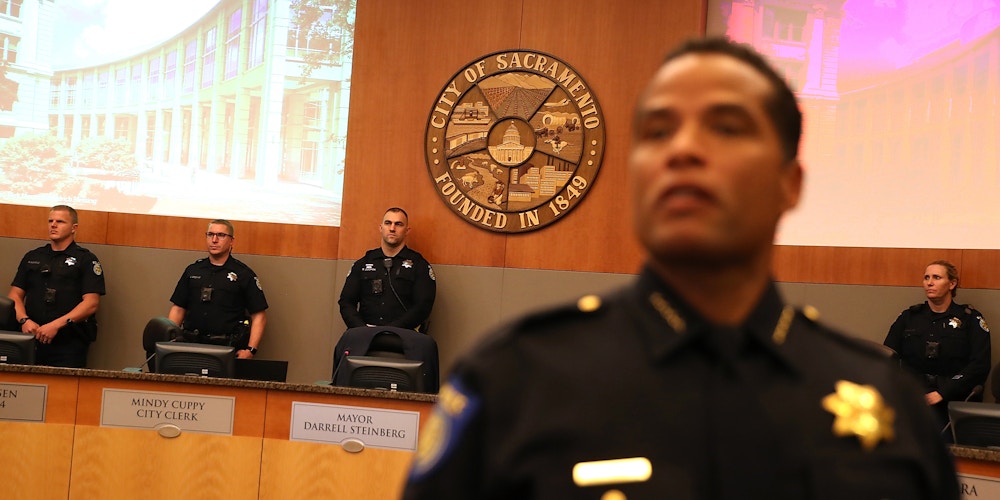
Sacramento police officers stand guard at a city council meeting to address concerns over the shooting death of Stephon Clark at Sacramento City Hall on March 27, 2018 in Sacramento, California
Sacramento, California, has been all over the news for the past month, since police shot and killed an unarmed black man, 22-year-old Stephon Clark, in the backyard of his own home on March 18. An independent autopsy conducted at the family’s request showed that Clark was shot six times in the back, according to the Los Angeles Times. As protests over the death raged, activists, both locally and around the country, called for the district attorney there, Anne Marie Schubert, to file charges, or even just make a strong statement on the case. Yet she remained silent.
All the while, Schubert’s political campaigns have benefitted from the largesse of law enforcement unions and associations. According to an analysis by The Intercept, about one-third of the contributions she received across her two campaigns to be Sacramento County’s district attorney — one of which is currently ongoing — came from law enforcement sources or those close to law enforcement.

Two years before Clark was killed, police shot and killed a mentally ill, homeless man named Joseph Mann. Police tried to run Mann over with their car, according to a review of video from the incident by the Sacramento Bee. On a dashcam recording, an officer could be heard saying, “Fuck this guy. I’m going to hit him.” His partner responded: “OK. Go for it.” While officers claimed that Mann lunged at them before they shot and killed him in a hail of gunfire, the Sacramento Bee found that Mann’s feet were actually planted at the time of the shooting.
About one-third of the contributions Schubert received in campaigns came from law enforcement sources.
Mann’s story — and Schubert’s complete refusal to file any charges — never really got national coverage, but it ripped out the hearts of activists and organizers on the ground in Sacramento. And this is part of the reason why the community responded so forcefully in the wake of Clark’s killing: They were already, in the words of Fannie Lou Hamer, “sick and tired of being sick and tired.”
The Sacramento News & Review, an alt weekly, outlined several cases in which Schubert has been unwilling to take on police when misconduct is suspected — noting that her office has “prosecuted more activists for civil disobedience than she has officers involved in misconduct.” Since 2015, when Schubert took office, the newspaper said, the district attorney’s office has declined to file charges in 21 shootings involving police and also in 13 cases of death of people in police custody. “The office has yet to publicly announce decisions on eight officer-involved shootings and four in-custody deaths from last year, according to an SN&R review of public data,” Raheem Hosseini reported. “This year so far, there is the Clark homicide and two deaths that occurred inside Sacramento County’s downtown jail, which is run by the Sheriff’s Department.”
In Sacramento, Sheriff Scott Jones is known as a staunch ally of President Donald Trump. Just last month, the editorial board of the Sacramento Bee put Jones on blast for pandering to Trump during a White House appearance.
Like Schubert, Jones is an example of a bewildering phenomenon: a lifelong Republican in the middle of a city and county dominated by Democrats. Sacramento’s U.S. congressperson is a Democrat; the current mayor is a Democrat; and the last mayor was a Democrat. In the last presidential election, Hillary Clinton beat Trump in Sacramento County by almost 20 percentage points.
Despite near complete Democratic control of local politics, a Republican — Schubert — occupies a key position in the local justice system. And she does it with the help of police union money.

Sequita Thompson recounts the horror of seeing her grandson Stephon Clark dead in her backyard after he was shot by police, on March 20, 2018, in Sacramento, Calif.
As it turns out, the $13,000 that Schubert received from law enforcement groups after Clark’s death was just a drop in the bucket. The Intercept’s analysis of Schubert’s campaign contributions, based on public filings made available online, shows that she is backed by the law enforcement community lock, stock, and barrel. While Schubert is under fire now for the donations in the wake of Clark’s killing, these sorts of contributions have been commonplace during her campaigns. (Disclosure: I help run Real Justice PAC, which endorsed and funnels money to Noah Phillips, Schubert’s opponent in the 2018 district attorney race, as well as Milo Fitch, who is running against Jones to be Sacramento County sheriff.)
For the three campaigns she has raised money for — a short-lived California superior court judge race and two races for district attorney — Schubert has taken in well over $1 million in disclosed contributions, according to news reports and California campaign contribution databases. Of that money, about $420,000 came from law enforcement groups or people associated with law enforcement, including $200,000 in loans from a former official with the Sacramento County Sheriff’s Department. A law enforcement association’s political action committee also independently spent more than $50,000 on her first campaign for district attorney. That brings the total amount of law enforcement cash spent on Schubert’s election efforts to around $470,000.
Of Schubert’s campaign cash, about $420,000 came from law enforcement groups or people associated with law enforcement.
Amid so many incidents in which Schubert has had a duty to critically investigate local law enforcement officials’ actions, she’d been receiving funds from law enforcement-related sources.
Speaking to Sacramento’s ABC10, lawyer and former lobbyist Mark Reichel outlined some of the potential conflicts in the eyes of the public. “The person with more money usually wins. And when you get money there’s obviously a tie to it. There’s a clear conflict of interest that the public sees, because the DA is going to have to determine whether or not to file criminal charges,” he said. “When you decide to make that decision, if you realize, well, you could be cut off from the funding that keeps you in your job, you’re in a clear conflict of interest. So, it’s not going to pass the smell test.”
Campaign cash from law enforcement began flowing to Schubert in 2009. At the time, she was serving as an assistant district attorney and mounting a campaign to run for Sacramento County superior court judge. The Sacramento County Deputy Sheriffs’ Association PAC gave her campaign $1,000, according to public filings available online. Schubert’s campaign — which a local magazine described as a “conservative, law and order candidacy” — ended when California’s governor made an appointment, removing the possibility of an open seat that year.
For the next several years, Schubert laid low in her role as assistant district attorney. In 2013, she began considering a run for the district attorney’s seat. The first large donation to Schubert from law enforcement came that summer: a $10,000 contribution, again from the Sacramento County Deputy Sheriffs’ Association PAC.
Over the next few months, donations for her candidacy would roll in from police unions all over California. The Intercept identified at least 15 different law enforcement-related contributions, totaling more than $150,000, including loans, in support of Schubert’s 2014 bid to become district attorney. Law enforcement special interest groups that I never even knew existed — including groups supporting the probation industry — gave to her campaign. (The figures do not include donations from individual employees of different law enforcement agencies.)
She received $500 from the Los Angeles Police Protective League’s PAC. Then, in October 2013, she got $2,500 from the Peace Officers Research Association of California PAC, headquartered in Sacramento. In December 2013, she took in $5,000 from the California Statewide Law Enforcement Association Public Works PAC; another $1,000 from the Sacramento County Deputy Sheriffs’ Association PAC; another $500 from the Peace Officers Research Association of California PAC; and $5,000 from a group that called itself Friends of Sheriff Scott Jones.
“To suggest that a campaign contribution somehow influences the donee’s decision-making process is asinine,” Jones said in a statement to The Intercept, noting that he had not donated to Schubert’s current run for district attorney. “To think otherwise would be to suggest that the hundreds of people that have donated to me somehow expect leniency in enforcement of the law against them, or that donors to a legislative candidate somehow expect laws to be passed that advantage them personally or exclude them from compliance with that law.”
“I, like most donors, donate to candidates who appear to share my values on issues that are important to me, and who I believe have performed — or will perform — exceptionally in the office they hold or are seeking,” Jones added.

In February 2014, Schubert received $2,500 from the California Statewide Law Enforcement Association Public Works PAC. In April, she got a check for $5,000 from the California Association of Highway Patrolmen. In May, she received $3,000 from the California Correctional Peace Officers Association Local PAC, and then yet another $10,000 from the California Statewide Law Enforcement Association Public Works PAC.
In June 2014, the California Correctional Peace Officers Association Local PAC chipped in yet another $5,000. In September, the California Statewide Law Enforcement Association Public Works PAC gave $10,000 to her campaign yet again. That same month, Schubert received $2,500 from the Sacramento County Law Enforcement Managers Association and $300 from the Sacramento County Probation Association PAC.
Public filings also show that the California Statewide Law Enforcement Association Public Works PAC spent over $50,000 in independent expenditures — spending on races not made in coordination with candidates or their campaigns — to support Schubert’s 2014 bid.
Perhaps most disturbing, though, was the single largest registered financial transaction that Schubert’s campaign undertook in her 2014 race: a $100,000 loan from a man named Michael Tsuchida. That’s a huge loan for a district attorney’s race. Tsuchida does not have much of an online paper trail, but a single quote from Schubert herself in a 2014 news report told us more about him. When asked who Tsuchida is, Schubert replied that he’s “a retired sheriff’s lieutenant who feels very strongly that I’m the right person for this position.”
With the help of law enforcement groups, Schubert dramatically outraised her opponent. Flush with cash from police associations all over California, Schubert went on to win her bid for district attorney of Sacramento.
Once Schubert was ensconced as the top prosecutor in Sacramento County, law enforcement groups kept giving to her — even though she was, at the time, between races and no longer running for anything. In May 2015, she received $500 from the Peace Officers Research Association of California PAC.
The next donation she received was peculiar. Despite still not being in the middle of a campaign, she got $25,000 from the Sacramento County Deputy Sheriffs’ Association PAC in October 2016. When a district attorney is in the middle of a campaign season, they justify receiving donations from police unions as being necessary for winning a campaign, but how is a donation justified when a campaign is years away? (Schubert’s district attorney and campaign offices did not respond to requests for comment from The Intercept.)
While Schubert was not running for anything in 2016, a handful of very important criminal justice reforms made their way before California voters in the form of ballot measures. Schubert got involved: She gave $2,500 to No on Prop 62/Yes on Prop 66, the campaign to save the death penalty in California and speed up the death row appeals process. In doing so, Schubert stood in opposition to the liberal consensus of editorial boards at the Los Angeles Times, the San Francisco Chronicle, and her local paper, the Sacramento Bee. Her position ended up winning out with California voters by a narrow margin, and the death penalty was preserved.
On Prop 57, though, Schubert did something that was out of step with voters statewide. She spent $9,223.46 on printing and processing, and $13,970.94 on postage, for a statewide mailer asking voters to oppose Prop 57 — a ballot measure that was perhaps the most comprehensive and popular criminal justice reform initiative ever put before California voters. Designed to speed up parole for nonviolent offenders and to overhaul policies on juveniles in the justice system, voters approved the measure 64 percent to 36 percent, by a margin of nearly 4 million votes. Despite polls indicating that the measure was hugely popular, Schubert fought against it tooth and nail.
As Schubert’s re-election race approached, donations from law enforcement groups kept pouring into her campaign coffers. In March 2017, Schubert received $1,500 from the Sacramento Police Officers Association Political Activity Fund; then another $1,500 from the Sacramento County Probation Association PAC; $3,000 from the Sacramento County Law Enforcement Managers Association; and $500 more from the Peace Officers Research Association of California. Then came $3,000 from the Sacramento County Deputy Sheriffs’ Association PAC, which has been the most reliable donor to Schubert’s campaigns — her next large donation from the group was $5,000 in September 2017. The next month, Schubert received another $2,500 from the Sacramento County Law Enforcement Managers Association, then $5,000 from the Sacramento Police Officers Association Political Activity Fund, and yet another $5,000 from the California Association of Highway Patrolmen PAC.
On October 18, 2017 — already flush with cash — Schubert finally made an official announcement that she would run for re-election. The money from law enforcement, naturally, continued to roll in. She received $1,000 from the San Francisco Police Officers Association PAC; $5,000 from the California Correctional Peace Officers Association Local PAC; $1,000 from the Sacramento County Probation Association PAC; and a large donation of $10,000 from the California Statewide Law Enforcement Association Public Works PAC. (Other than Jones, none of the other PACs responded to requests for comment from The Intercept.)
How willing do you think Schubert is going to be to prosecute police brutality, corruption, and misconduct when those same cops are the ones funding her campaign?
Can we be fully sincere for just a moment? Do you see all of those contributions from the law enforcement community that Schubert has received? What do you think police expect to get from those contributions? Or, here’s another way of looking at: How willing do you think Schubert is going to be to prosecute police brutality, corruption, and misconduct when those same cops are the ones funding her campaign?
The thing is, we have a minor example that gives a pretty good indication of Schubert’s unwillingness to go after police. On December 19, 2017, California State Auditor Elaine Howle sent a letter to Schubert urging her to prosecute Jones, the sheriff of Sacramento County. Jones, according to the auditor, who serves in a watchdog capacity, had committed a misdemeanor offense by deliberately releasing information that he was specifically told he could not release, despite multiple verbal and written warnings.
That would’ve been a great time for Schubert to recuse herself from the case. A PAC called Friends of Sheriff Scott Jones has donated to her campaigns. His name and endorsement were literally on her yard signs when she campaigned for district attorney in 2014. He appeared at her most recent campaign kickoff event, and she at his. The union for his department is one of the largest single financial contributors to her campaigns.
Instead of recusing herself, Schubert announced that she would be ignoring the auditor’s request to file charges against Jones. Of course she ignored it. Jones is an ally of Schubert’s.
The support from the Sacramento sheriff’s department and its allies is still rolling in. According to a recent filing, Schubert received a loan in March from Tsuchida, the same man who lent $100,000 to her 2014 campaign. The new loan was for $50,000. On April 18, Schubert’s campaign took in yet another loan from Tsuchida, again for $50,000. (Multiple attempts to reach Tsuchida by publicly listed phone numbers went unanswered.)
Another recent campaign finance disclosure for Schubert’s bid tells more of the same story. What I saw was so outrageous, so beyond the pale, that I could hardly believe it. This month, Schubert’s campaign — already mired in controversy for receiving money from police unions right after the shooting death of Clark — filed a disclosure for an in-kind donation, in the amount of $3,187.67, from a local Sacramento police union. Guess what the form says it’s for?
Rent, internet, and electricity.
It appears that the local police union is literally providing Schubert with free office space and utilities for her campaign.
 Stevante Clark, whose brother Stephon was shot and killed by Sacramento police, reacts as he meets with mourners outside of the funeral services for Stephon at the Bayside Boss Church on March 29, 2018, in Sacramento, Calif.
Reichel, the attorney and former lobbyist, told ABC10, “If they are your landlord, it’s really hard to make a decision that is conflicting with or adverse to the interests of your landlord.”
And the donations are still coming in. On April 20, the California Correctional Peace Officers Association PAC gave Schubert’s campaign $75,000 — her largest contribution yet from law enforcement, aside from Tsuchida’s loans.
In what universe would she ever hold them accountable? Ever? Any reasonable person would understand that all of these donations and loans from the law enforcement community create the appearance of a serious conflict of interest for a district attorney. How in the world is a prosecutor ever supposed to be objective in the pursuit of justice when it comes to police misconduct if the votes and money from those very officers helped them get into office?
Police and prosecutors already work together day in and day out. They are two fingers on the same hand as far as the justice system is concerned. Because of this, it’s already hard to believe that prosecutors would ever be willing to hold police accountable, but when hundreds of thousands dollars are changing hands from police to prosecutors like this, justice appears not just to be unlikely, but impossible.

