
Keeping The Sheeple Up To Date With Reality!!!
Tuesday, October 6, 2015
America Is Upset That She Is # 1 Democrats & Republicans Agree 100%
More than 2 million Americans woke up behind bars today. That's because the U.S. puts more people in prison than any other country. Finding ways to reform the system is uniting Democrats and Republicans in Washington.

WATCH: White Florida Cop Fired After Tasering Man Who Did Not Resist Arrest

A White Zephyrhills, Florida police officer has been fired after footage from his body-cam video showed him releasing a Taser on an unarmed Black man whose hands were up in surrender, according to the Tampa Bay Times.
The officer, identified as 36-year-old Tim Claussen, was fired last week following an internal investigation of the incident on Sept. 9, police chief David Shears told the news outlet.
Claussen arrived at the home of the victim, Lester Brown, that evening to investigate a theft that occurred earlier at a local retailer in the community, the report says.
Via Tampa Bay Times:
“Come outside now,” Claussen said, “or you’re about to get tased. This is the last time.”
Brown, hands still up, didn’t move. Moments later the video camera at the tip of the Taser showed Claussen firing the electroshock weapon. Brown tried to run but collapsed.
“You just made it a lot worse on yourself, Mr. Brown,” the officer said.
While lying on his stomach on the floor, the officer asked Brown why he made it worse for himself, leading him to respond, “cause I’m in my house?”
The firing comes at a time of rising scrutiny of police conduct and how officers use force, namely against Black men and women. But Capt. Derek Brewer told the news site that there was no evidence the incident was “racially motivated.”
Monday, October 5, 2015
Brzezinski: Obama should retaliate if Russia doesn't stop attacking U.S. assets #OutOfTheShadows


The United States should threaten to retaliate if Russia does not stop attacking U.S. assets in Syria, former national security adviser Zbigniew Brzezinski wrote in a Financial Times op-ed published Sunday, urging "strategic boldness," with American credibility in the Middle East and the region itself at stake.
Moscow's apparent decision to strike non-Islamic State targets and those of Syrian rebels backed by the Central Intelligence Agency "at best" reflects "Russian military incompetence," and worst, "evidence of a dangerous desire to highlight American political impotence," wrote Brzezinski, the national security adviser for former President Jimmy Carter and a strong supporter of current President Barack Obama.
Story Continued Below
And if Russia continues to pursue non-ISIL targets, the U.S. should retaliate, he added.
"In these rapidly unfolding circumstances the U.S. has only one real option if it is to protect its wider stakes in the region: to convey to Moscow the demand that it cease and desist from military actions that directly affect American assets," he said.
"The Russian naval and air presences in Syria are vulnerable, isolated geographically from their homeland," Brzezinski noted. "They could be 'disarmed' if they persist in provoking the US."
The problem in the Middle East is bigger than Syria, Brzezinski wrote, and it would behoove Russia to cooperate with the U.S., who cannot as it did in the past, rely upon the United Kingdom and France to play a "decisive role" in the region.
"But, better still, Russia might be persuaded to act with the U.S. in seeking a wider accommodation to a regional problem that transcends the interests of a single state," he added.
Instead of what he calls a "new form of neocolonial domination," the United States, along with China and Russia, must act in concert to protect their mutual interests, he warned.
"China would doubtless prefer to stay on the sidelines. It might calculate that it will then be in a better position to pick up the pieces. But the regional chaos could easily spread northeastward, eventually engulfing central and northeastern Asia. Both Russia and then China could be adversely affected. But American interests and America’s friends — not to mention regional stability — would also suffer. It is time, therefore, for strategic boldness," he concluded.
9 People Dead In South Carolina Flooding


WEST COLUMBIA, S.C., Oct 5 (Reuters) - Floodwaters inundating South Carolina after unprecedented rainfall have resulted in nine deaths, more than 500 road and bridge closures and hundreds of rescues of people trapped in homes and cars by the rising water, officials said on Monday. Officials expect flooding to continue in half the state.
Governor Nikki Haley warned residents to remain on alert as rain continued to fall in some of the hardest-hit areas, including the state capital of Columbia, which saw its wettest days on record over the weekend.
"This is not over," Haley said at news conference. "There's still a lot of water out there."
More than 2 feet of rain have fallen in the past three days in parts of South Carolina, and moderate to heavy rain persisted on Monday in the state's saturated northeastern corner and southeastern North Carolina, the National Weather Service said.
The flooding closed schools and government offices, stranded motorists and led to dramatic rescues, including a mother and her 15-month-old child who were plucked by a U.S. Coast Guard helicopter from a flooded home in Huger, South Carolina.
Five people drowned when floodwaters swamped their vehicles and four others died in weather-related car crashes, the state Department of Public Safety said. A state transportation department employee was killed after his work truck was overturned and swept away by rushing waters, the agency said.
The severe weather was also blamed for two deaths in North Carolina, officials said.
Nearly 1,000 people have found refuge in shelters around South Carolina, officials said, and water distribution centers were being opened after the downpours left an estimated 40,000 people without drinking water. About 26,000 were without power, officials said.
In Columbia, police and fire officials were going door to door looking for anyone who might still be trapped in houses and to test the stability of buildings damaged by the deluge.
Columbia resident Tommy Rollins, 67, said he went to bed Saturday night after watching a football game and woke up at 4 a.m. Sunday to the sound of rushing water.
"It sounded like someone was taking a shower in every room," he said. "Within 10 minutes, water was bubbling up through the hardwood floors. We had about 30 minutes and then it was 4 feet deep."
Rollins and his wife grabbed a change of clothes and some toiletries and stepped off their porch into chest-deep rushing water before being brought to safety in a neighbor's boat, he said.
Haley and meteorologists said additional flooding concerns remain as rains in the Midlands and Upstate South Carolina flow downstream to the already-swamped area known as the Lowcountry.
That area includes the peninsula of Charleston, which emergency officials have reopened to allow people in and out but where more than 30 streets remained flooded on Monday.
"It's still a pretty desperate situation," National Weather Service forecaster Dave Loewenthal said. "We are going to have river flooding for weeks, if not months." (Additional reporting by Harriet McLeod in Charleston, S.C. and Gene Cherry in Hatteras island, North Carolina; Writing by Colleen Jenkins; Editing by Jonathan Oatis and Grant McCool)
Video Shows Cops Brutally Punching Unarmed Woman For a Seatbelt Violation
A woman in California has filed a federal lawsuit against a Carlsbad police officer, as well as the city of Carlsbad, for using excessive force after he repeatedly punched her in the face while arresting her for failure to wear a seat belt while driving.
The New York Daily News reported that the suit is being brought by 40-year-old Cindy Hahn, who was arrested and beaten in 2013 while her two young children watched helplessly.
According to Hahn’s 68-point complaint, on July 31, 2013, she was leaving a birthday party with her children (ages 7 and 11) when they walked by an empty parked vehicle with the alarm blaring.
Multiple police cruisers and officers surrounded the vehicle, but were taking no action to deactivate the alarm or locate the owner. When Hahn, the daughter of a police officer, asked one of the officers at the scene why they weren’t shutting off the car alarm, the officer, later identified as Officer Kenyatte Valentine, reportedly told Hahn to mind her “own fucking business.”
Hahn then called the police non-emergency line to complain about Officer Valentine’s behavior, which included cursing at her in front of her two minor children. After she reached her car and drove away, Valentine pulled her over, claiming she wasn’t wearing her seat belt. She was then pulled her from the vehicle by Valentine and another officer and pinned to the ground as her children watched.
Valentine then repeatedly punched her in the face while holding her on the ground. The incident was caught on cell phone video by another person walking by while other bystanders tried to intervene but were removed by additional officers who appeared on the scene.
After being subdued and beaten by the two officers, Hahn was charged with resisting arrest and battery on a police officer. However, once the video was released on social media and attracted the attention of local media outlets, those charges were dropped.
Hahn’s complaint states the following:
“Ms. Hahn was transported to the emergency room where she was diagnosed with head and brain contusions and subsequently diagnosed with a concussion based on the Defendant Police Officer’s violence. Ms. Hahn suffers permanent memory loss and brain trauma as well as other physical and emotional injuries from the beating.”
Carlsbad police officials released a statement saying the department looks forward to seeing the case adjudicated.
“We are prepared to provide a complete and detailed account of the facts of this incident in a courtroom, not in the media,” the statement said. They provided no additional information about the initial charges against Hahn being dropped after the video surfaced.
TPP deal: US and 11 other countries reach landmark Pacific trade pact
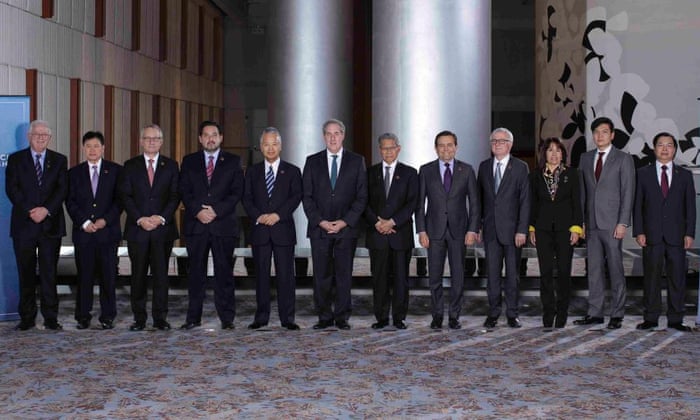
Trans-Pacific Partnership – the biggest trade deal in a generation – would affect 40% of world economy, but still requires ratification from US Congress and other world lawmakers
Trade ministers from 12 countries announced the largest trade-liberalizing pact in a generation on Monday. In a press conference in Atlanta, trade ministers from the US, Australia and Japan called the the Trans-Pacific Partnership an “ambitious” and “challenging” negotiation that will cut red tape globally and “set the rules for the 21st century for trade”.

The deal – in the works since 2008 – is a major victory for the US president, Barack Obama. “This partnership levels the playing field for our farmers, ranchers and manufacturers by eliminating more than 18,000 taxes that various countries put on our products,” the president said in a statement. “It includes the strongest commitments on labor and the environment of any trade agreement in history, and those commitments are enforceable, unlike in past agreements.”
While it still faces major hurdles, not least in Congress, the deal could reshape industries and influence everything from the price of cheese to the cost of cancer treatments. It is expected to set common standards for 40% of the world’s economy, become a new flashpoint for the 2016 presidential campaign, and could become a legacy-defining agreement for the Obama administration.
The deal is seen as a challenge to China’s growing dominance in the Pacific region. China had been invited to join the trade group but balked at restrictions that the deal would have placed on its financial sector and other areas.
“Long after the details of this negotiation like tons of butter have been regarded as a footnote in history, the bigger picture of what we have achieved today remains,” said New Zealand’s trade minister, Tim Groser. “It remains inconceivable that the TPP bus will stop at Atlanta.”
The final round of negotiations in Atlanta, which began on Wednesday, had got stuck over the question of how long a monopoly period should be allowed on next-generation biotech drugs, until the United States and Australia negotiated a compromise. Negotiations went as late as five o’clock this morning, the US trade representative, Michael Froman, said.
The TPP deal has been controversial because of the secret negotiations that have shaped it over the past five years and the perceived threat to an array of interest groups from Mexican auto workers to Canadian dairy farmers.
Although the complex deal sets tariff reduction schedules on hundreds of imported items from pork and beef in Japan to pickup trucks in the United States, one issue had threatened to derail talks until the end: the length of the monopolies awarded to the developers of new biological drugs.
Negotiating teams had been deadlocked over the question of the minimum period of protection of the rights to data used to make biological drugs, by companies including Pfizer Inc, Roche Group’s Genentech and Japan’s Takeda Pharmaceutical Co.
The United States had sought 12 years of protection to encourage pharmaceutical companies to invest in expensive biological treatments like Genentech’s cancer treatment Avastin. Australia, New Zealand and public health groups had sought a period of five years to bring down drug costs and the burden on state-subsidized medical programs.
Negotiators agreed on a compromise on minimum terms that was short of what US negotiators had sought, people involved in the closed-door talks said. The agreement would protect the data for between five and eight years, the New York Times reported.
“This is one of the most challenging issues in the negotiations,” Froman said about biologics. He said member countries believe the TPP “incentivizes the development of these new live-saving drugs while ensuring access to these medicines”.
The Biotechnology Industry Association, in Washington DC, said it was “very disappointed” by reports that US negotiators had not been able to convince Australia and other TPP members to adopt the 12-year standard approved by Congress.
“We will carefully review the entire TPP agreement once the text is released by the ministers,” the industry lobby said in a statement.
Final hours
A politically charged set of issues surrounding protections for dairy farmers was also addressed in the final hours of talks, officials said. New Zealand, home to the world’s biggest dairy exporter, Fonterra, wanted increased access to US, Canadian and Japanese markets.
Separately, the United States, Mexico, Canada and Japan also agreed rules governing the auto trade that dictate how much of a vehicle must be made within the TPP region in order to qualify for duty-free status.
The North American Free Trade Agreement between Canada, the United States and Mexico mandates that vehicles have a local content of 62.5%. The way that rule is implemented means that just over half of a vehicle needs to be manufactured locally. It has been credited with driving a boom in auto-related investment in Mexico.
The TPP would give Japan’s automakers, led by Toyota Motor Corp, a freer hand to buy parts from Asia for vehicles sold in the United States but sets long phase-out periods for US tariffs on Japanese cars and light trucks.
The TPP deal announced on Monday also sets minimum standards on issues ranging from workers’ rights to environmental protection. It also sets up dispute settlement guidelines between governments and foreign investors separate from national courts.
Saturday, October 3, 2015
Former US drone operator tells IN THE NOW he is sorry
Former US drone operator Brandon Bryant tells IN THE NOW that he couldn't stand himself for killing people he didn't know and then see Obama and Brennan on TV say that there were no civilian casualties. Bryant says the inside of American’s drone program is diseased and people should know this. When asked by IN THE NOW's host Anissa Naouai what he would tell to the families his victims, Brandon said "I'm sorry".
"In the Now" with RT's Senior Political correspondent Anissa Naouai is the first dedicated nightly Primetime show to air live out of our Moscow headquarters. Host Anissa Naouai has worked in the field for almost a decade and has reported from over 80 cities across the globe. Now from Monday to Thursday viewers can enjoy fresh, honest, and hard-hitting news coverage on some of the world's most pressing issues with one of RT's most experienced journalists . We'll put the spotlight on stories you'll never hear on mainstream networks or even in RT's daily news bulletins. "In the Now" - 8pm Moscow, 5pm London, 12pm New York.
Subscribe to:
Posts (Atom)